
Manufacturing Plant Roofing in St. Paul, MN
Roof inspection, repair and replacement for manufacturing plants in St. Paul, MN, with chemical exposure notes, shutdown planning and dated roof records.
Request a Roof Assessment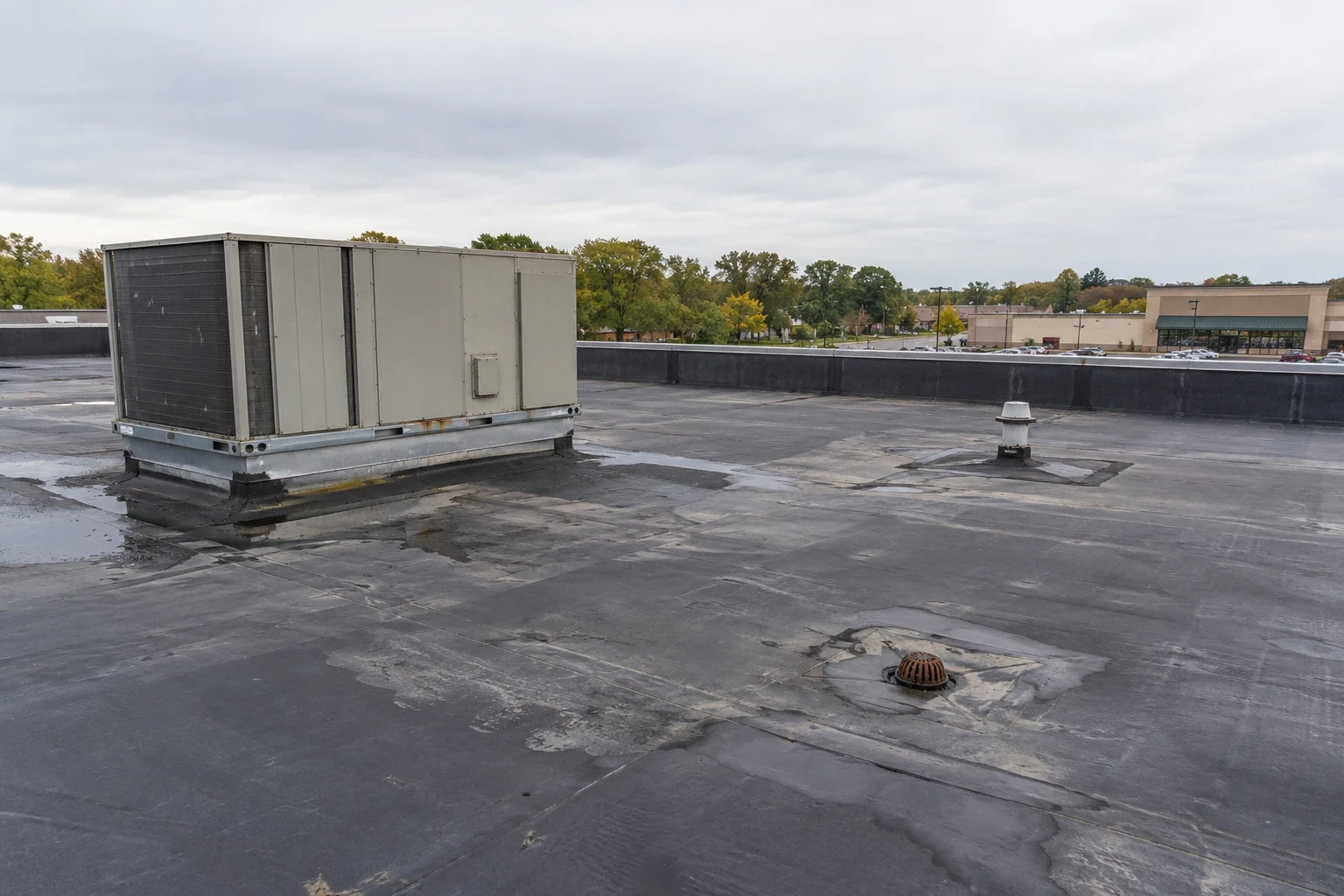
Manufacturing Plant Roofing
Residue tells the story on the roof of a manufacturing plant in St. Paul, MN: a pale crust around an exhaust stack, a dark stain downwind of a vent, a membrane gone soft where a process line drips. The first job in the inspection log is to map those marks before anyone talks about patching, because what a plant puts into the air decides how long the sheet beneath it lasts. We photograph each stack, take readings of the membrane nearby and date the entry, and the pattern across a season shows which exposure is doing the damage.
The Twin Cities area has a deep industrial base. 3M employs about 12,000 people in Maplewood, Medtronic and Cummins Power have large operations in Fridley, and the Ford assembly plant in Highland Park ran until 2011 before its site was set aside for redevelopment. Those employers establish industrial context, while roof history requires its own records of material, repairs and observed exposure.
Mapping Residue, Corrosion and Chemical Contact Around Every Stack
Exhaust leaves a pattern. Oils, solvents, steam and fine dust settle on the roof in the direction the wind carries them, and a membrane that handles rain easily can swell, stiffen or crack where it meets those contaminants. We walk the plant with a plan in hand and mark each stack, fan and vent, then note the discoloration, softening or pitting we find within the first few feet downwind. A reading with a durometer or a simple flexibility check is taken at the worst spot and compared with a clean area.
That comparison matters because a single-ply sheet varies in how it tolerates grease and chemicals. PVC roofing and KEE options require product-specific compatibility review for the actual contaminant and temperature before selection. The log lets the owner see why a particular sheet was chosen, and gives the next inspection a documented basis for comparison.
Reading Heat, Vibration and Concentrated Equipment Loads on the Deck
A plant roof can carry substantial equipment whose loads need structural review. Makeup air units, dust collectors, cooling towers and exhaust ductwork sit on curbs and rails across the deck, and each one transmits vibration and heat. Heat from a stack can soften a membrane or dry out a sealant faster than ambient sun does, and vibration works fasteners loose and cracks mastic at pipe penetrations. We record temperature differences at the surface, tap along the flashing at each support and photograph any fastener that has moved.
Foot traffic compounds the wear, because maintenance crews return to the same units each week. Marked paths, protective pads and repaired punctures are part of the record. Where supports sit directly on the membrane, we describe how curbs and equipment supports are rebuilt so the load lands on the structure and the water leaves the unit.
Planning Work Around Production Lines, Shutdowns and Hot Work
A plant cannot always pause for a roof. The practical route is to find the maintenance window already on the calendar, schedule the loudest or smokiest work for that window and keep the rest of the job in sections that can be closed each day. Hot work such as torch application or welding near flammable process areas needs a permit, a fire watch and a plan for the sprinkler zone below, and we confirm those before any equipment is lifted onto the roof.
Our method for reroofing an occupied building applies directly: protect air intakes, cover inventory or open machinery as the plant requires, and give the production manager a daily forecast of what is being opened. If the plant has an environmental or safety team, we send them the material data sheets in advance. Roof access is logged so contractor badges, escorts and safety training are all matched to the schedule.
Judging Snow, Cold and Interior Moisture in a Heated Plant
A heated plant sheds warmth upward, and in a Minnesota winter that warmth melts snow on the deck and refreezes it at the eaves. Ice dams form when heat escapes through a thin roof assembly, and a plant with humid process air adds condensation under the deck on top of it. Twin Cities records for the 2013-14 winter show substantial snowfall and severe cold. Seasonal snowfall is not the weight accumulated on a particular roof. A plant roof that has to endure a winter like that needs insulation and vapor control matched to the interior, and our snow and ice roof damage repair findings show where a particular plant loses heat.
Structural limits belong to the engineer, who works from a fifty psf ground snow load set for Ramsey, Dakota and Washington counties. Our contribution is the measured layer count, the insulation thickness and the position of every drift-forming wall, so that any added equipment is judged against real conditions rather than the original drawings.
Keeping Roof Records Ready for Insurers, Auditors and Owners
A leak above a production line stops output as surely as a power failure, so adjusters ask what the loss cost and when the roof was last checked. The log supplies the roof condition and repair timeline; interruption costs require the operator's records: dated images from before the event, moisture readings after it and a record of the repair. When severe weather hits, such as the July 28, 2025 storm that brought golf-ball hail and winds near 70 mph across the Twin Cities, the earlier file separates new damage from older wear.
Safety and environmental auditors also like documents they can open without a meeting. Our records for manufacturers list roof penetrations and the process each serves, which helps when equipment is moved and a curb is left open. At Maplewood, Fridley or Cottage Grove, where freight corridors run past large employers, the same file format works for every building an owner runs.
Questions We Hear
Which membrane survives exhaust that carries oils or solvents?
Product-specific compatibility with the actual contaminant governs membrane selection. PVC and KEE options need that review rather than a general assumption of solvent resistance. The exact choice follows the contaminant, the temperature at the stack and the roof's slope, so we test a sample of the old membrane near each exhaust point. The observed condition and applicable product requirements go into the file with the reason for the choice.
Can roof work happen during production without risking the line?
Yes, when the roof is divided into sections that can be sealed each day and the loudest work is held for the planned maintenance window. Air intake protection or operating changes are coordinated with facility personnel, material data sheets go to the safety team and hot work follows a permit. Production managers get a forecast of what will be opened each shift.
Why does condensation drip from the deck in winter when the roof is not leaking?
Warm humid air from the plant rises and meets the cold underside of the deck, where it turns to water. The drips often fall far from any opening in the membrane. Moisture readings on the roof side and a look at the insulation confirm whether the water is coming from above or condensing below.
How should the roof be handled when production equipment is moved?
Every disconnected line leaves an open pipe or curb that needs to be capped and flashed the same day. We compare the move plan with the penetration map in the file, then seal each opening and photograph it. A new roof record is added so the changed layout is documented.
Does a coating make sense on a plant roof that sees chemical exposure?
Occasionally, but the coating has to be rated for the contaminant, and the sheet beneath has to be sound and dry. Test patches can help evaluate bond; chemical suitability requires the product requirements and actual exposure to be reviewed. Where residue has already softened the membrane, a new sheet suited to the exposure is the better investment, and a flex industrial roof without that exposure is the easier coating candidate.