
Big-Box Retail Roofing in St. Paul, MN
Roof inspection, repair, recover and replacement for big-box stores in St. Paul, MN, mapped by moisture readings and coordinated with customer access.
Request a Roof Assessment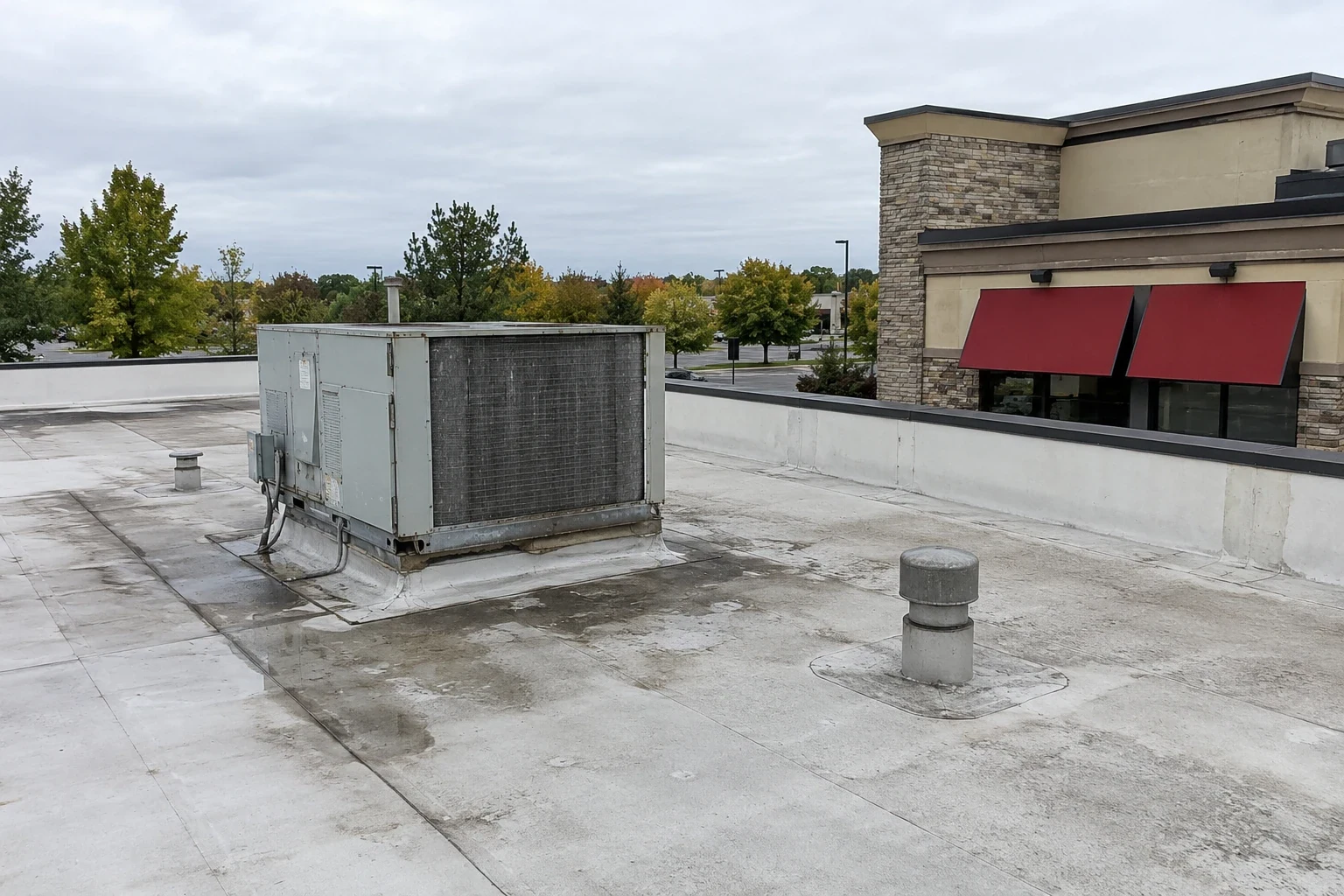
Big-Box Retail Roofing
A moisture reading taken at one drain on a big-box roof says very little about the far corner of the same roof. The sales floor below can be dry in the middle and soaked along the back wall, and the insulation between them may have been carrying water for a season before a ceiling tile showed it. In St. Paul, MN we cover a big-box roof in a measured grid, record a reading at every point, date the photographs and mark the wet zones on a scaled plan. The store manager then holds a map that shows where the roof is failing and where it is not.
Covering a Large Roof Field in a Measured Grid
The grid is the foundation of every decision that follows. We lay out test points across the roof, read each with a moisture meter and cut a core sample wherever the pattern suggests water in the assembly. An infrared and core-cut moisture survey makes the map continuous, and the cores confirm which anomalies are wet insulation and which are only warm air or shadow.
The map changes what a retailer pays for. Limited wet material can support evaluation of local repair or recover after removal and assembly suitability are checked, and the dated plan shows that without anyone relying on a sales opinion. When the same roof is surveyed a year later, the comparison between the two maps shows whether the wet areas are spreading.
Following Water to Docks, Vestibules and Roof Drains
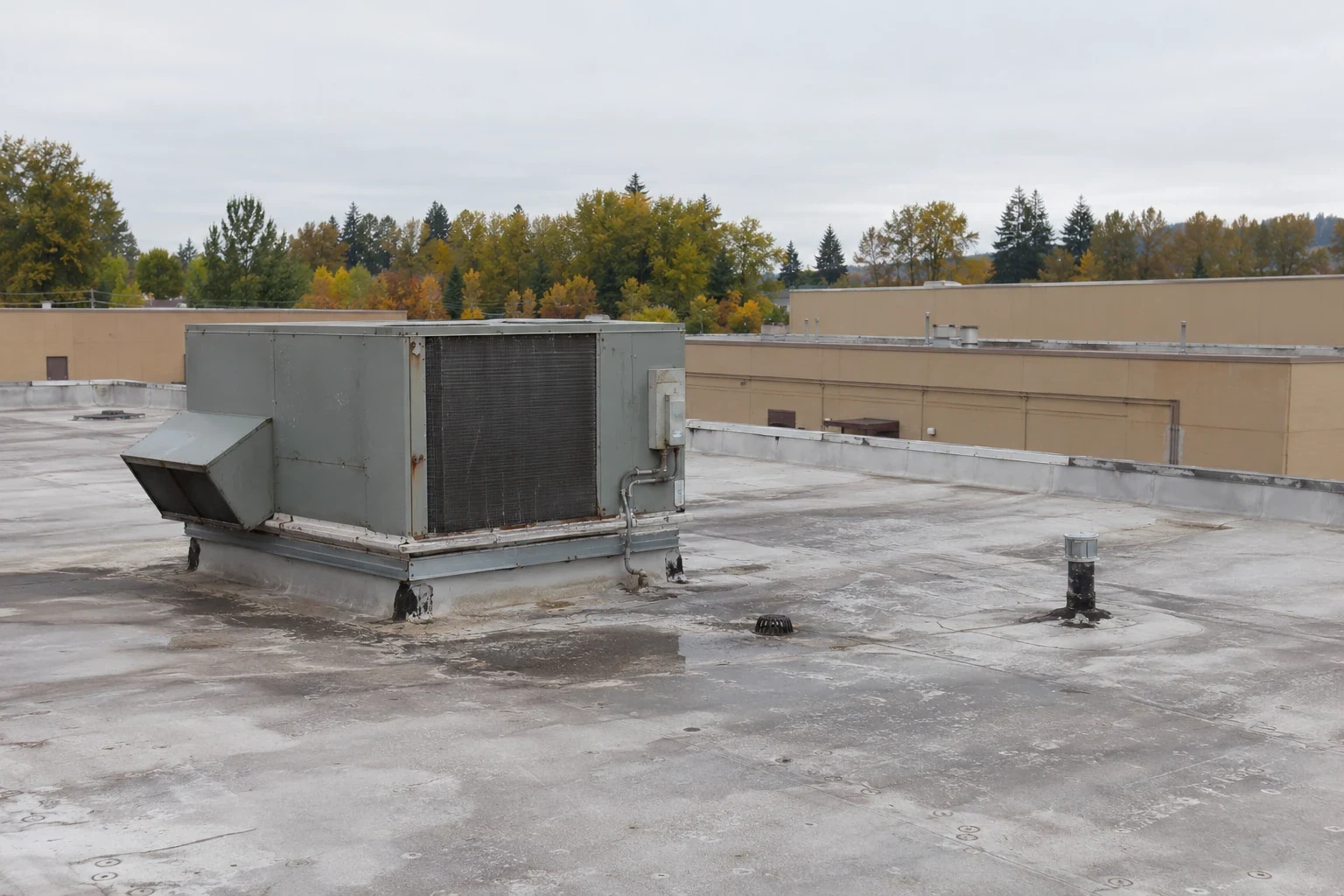
Big-box roofs fail at their interruptions. The receiving dock canopy, the vestibule where a low roof meets a tall wall, the vents over a service area, the signage supports bolted to a parapet and the rooftop units each carry flashings that age faster than the field membrane. We log them one by one with photographs, because a stain on the sales floor usually traces to a detail rather than to the main sheet.
Drainage deserves its own entry. A large, flat field depends on roof drains and scuppers to move melt off quickly, and a drain blocked by ice or debris puts weight on the deck. We check each drain after the first thaw, measure any ponding and record the depth, since water that stands for more than a day ages the membrane and adds weight that an engineer must assess with the roof geometry and building information; a county ground-snow design input is not spare capacity.
Choosing Between Recover, Coating and Replacement on a Store's Clock
A store lease and a roof warranty run on different clocks, and the roof decision has to respect both. When cores show dry insulation under a sound membrane, a coating extends the life of the roof at the lowest disruption. When the insulation is dry but the membrane is worn, a roof recover adds a new sheet over the old one without a tear-off, provided the structure can carry the added load and the code allows another layer.
Replacement is the answer where wet insulation spreads across large areas. A new roof has to carry the insulation that Minnesota's 2024 commercial energy code calls for, and the St. Paul permit submittal asks for material, roof area and drain size. We price replacement with those figures measured, and we give the retailer all three options in writing with the evidence for each. For national tenants, the same file serves retail and restaurant chains as a basis for capital requests.
Keeping the Store Open Through the Work
A big-box store needs an agreed plan for operation or temporary restrictions during roof work, so the plan starts from customers and merchandise. The roof is worked in sections. Interior protection goes up under the area being opened, rooftop hoisting is staged away from the front entrance, and noisy work moves to the hours when the store is quiet. At the close of every shift the section is sealed, photographed and dated.
Weather is the schedule's hardest variable. The storm of July 28, 2025 sent 70 mph gusts and large hail across the metro, which is a reminder that sections left open overnight are exposed. Retail roofs around Woodbury Village on Valley Creek Road at I-494, and along Burnsville's County Road 42, all work inside the same short roofing season, and the forecast gives the verdict each morning on whether a section opens. Maplewood counts Target and Costco among its larger employers, and stores of that scale are where the one-section-at-a-time rule matters most.
Setting One Standard for Every Store in a Region
A retailer with several locations in the metro needs comparable records, not a different report format from every vendor. We grade each store's roof on the same scale, record the same measurements and attach the same set of photographs, so a regional manager can rank the stores by condition and remaining life. The multi-site roof programs that come out of this work give a facilities group a repair queue and a replacement forecast.
Where the neighboring tenants are small shops instead of one large store, the same logic extends to shopping center roofing and, for stores that stock refrigerated food, to grocery store roofing, where the refrigeration plant adds its own load and its own penetrations.
A regional standard should make comparison easier without flattening site differences. Our shared roof-zone legend and report format let owners compare locations while preserving each store’s assembly, drainage, operating schedule, lease responsibilities and unresolved conditions. Each file retains its own approvals and repair boundaries.
Questions We Hear
How is merchandise protected when part of the roof is open?
Interior protection goes up before the roof is cut. Crews place a temporary ceiling or poly cover below the section being opened, move stock from the aisles beneath, and keep the opening small enough to close within the same shift. The shift ends with the membrane sealed, and the photographs taken at close are dated for the store's own record.
Why do ponds form on the roof after every thaw?
Long spans deflect a little under snow, and drains sit at the low points that the deflection does not always reach. The water stands in the shallow areas between them. We map the ponds after a thaw, measure their depth and compare the map with the drain plan, so the correction is made at the drain, the slope or the framing, whichever the record shows.
Is it worth recovering a roof that is mostly dry with a few wet areas?
Cutting out the wet sections and recovering the rest often costs less than a full tear-off. The moisture map marks the boundary of each wet zone, and the cores confirm it. The wet insulation is removed and replaced first, and the recover goes over the dry remainder, so the new sheet is not laid over trapped water.
What does a corporate real estate team need from the roof file?
A dated condition report for each store, with photographs, moisture readings, core findings and a stated remaining life. If a lease is being renewed or a store sold, that report puts the roof in the negotiation as a measured asset. Repair invoices and warranty documents go in the same file so nothing is searched for later.
How are hail strikes counted on a roof this large?
We divide the field into test squares, count hits in each square and photograph the worst marks beside a scale. The counts describe the sampled areas. We record their locations and limitations instead of treating them as proof of uniform damage across inaccessible roofing. The squares, the counts and the photographs are filed together, and the adjuster can retrace our steps on the roof.