
Flashing Failure Repair in St. Paul, MN
Flashing failure repair in St. Paul, MN: moisture readings at walls, curbs and penetrations, a rebuilt detail, and a dated before-and-after photo record.
Request a Roof Assessment
Flashing Failure Repair
On a flashing leak, the moisture reading climbs as the probe moves toward the wall. Readings taken along a parapet or curb can identify suspect locations. Water migration and meter limitations mean that a rising reading does not prove the flashing is the entry point; the detail still needs direct inspection and confirmation. A flat roof in St. Paul, MN has more of these edges than most owners count: walls, penthouses, pipe stacks, drains, skylight curbs, equipment rails and the long line of the perimeter.
Flashing is the part of a roof that has to follow a building as it moves. It is cut in at every wall and wrapped around every pipe, and it sits where a membrane, a metal cap and a masonry or steel surface all expand and contract at different rates. Our repair begins with a dated photograph and a moisture reading at each detail, so the owner can see which flashings failed and which still work.
Probing Curbs, Walls and Pipe Penetrations for Moisture
We take every flashing in turn and record its condition with the same three entries: how it is attached, what its surface looks like, and what is wet beneath it. Base flashing that has pulled loose from the wall leaves a gap at the top. A termination bar with sealant that has hardened and split has no seal left. A pipe boot that is cracked from sun exposure lets water run down the pipe. Each of these is photographed from close range, with a tape or a gauge for scale.
Then we work outward. Meter readings and suitable infrared observations help map suspected moisture for confirmatory openings. The pattern cannot establish when the leak started or how long it has been active. Our skylight and penetration flashing work and our repairs at rooftop equipment curbs follow the same sequence, because curbs and penetrations are where a flat roof sees the most foot traffic and the most mechanical work.
Tracing Thermal Movement at Parapets and Expansion Joints
A Minnesota winter pulls on every flashing. The metro bottomed out at -23 degrees on January 21, 2014, and between cold snaps and thaws a membrane can shrink away from the wall it is attached to, and the base flashing is left under tension with nothing behind it. The pull concentrates at corners, where two walls meet, and at expansion joints, where the building is designed to move. A split at an inside corner is rarely a random defect. It is where the movement the building needed went.
Older buildings have their own pattern wherever a wall is masonry. The Lowertown district records 37 contributing properties from several construction decades, reaching back to the 1870s. Union Depot's 1923 completion and 2012 restoration are building-history entries, useful for preservation coordination rather than dating its current flashing. Historic designation identifies review needs, not the wall condition or roof age. Where actual inspection finds deteriorated mortar or moving coping, the counterflashing support and water-shedding detail need assessment. We note whether the wall behind the flashing is sound before deciding how to reattach anything to it.
Separating Ice Dam Backup From a Defective Flashing
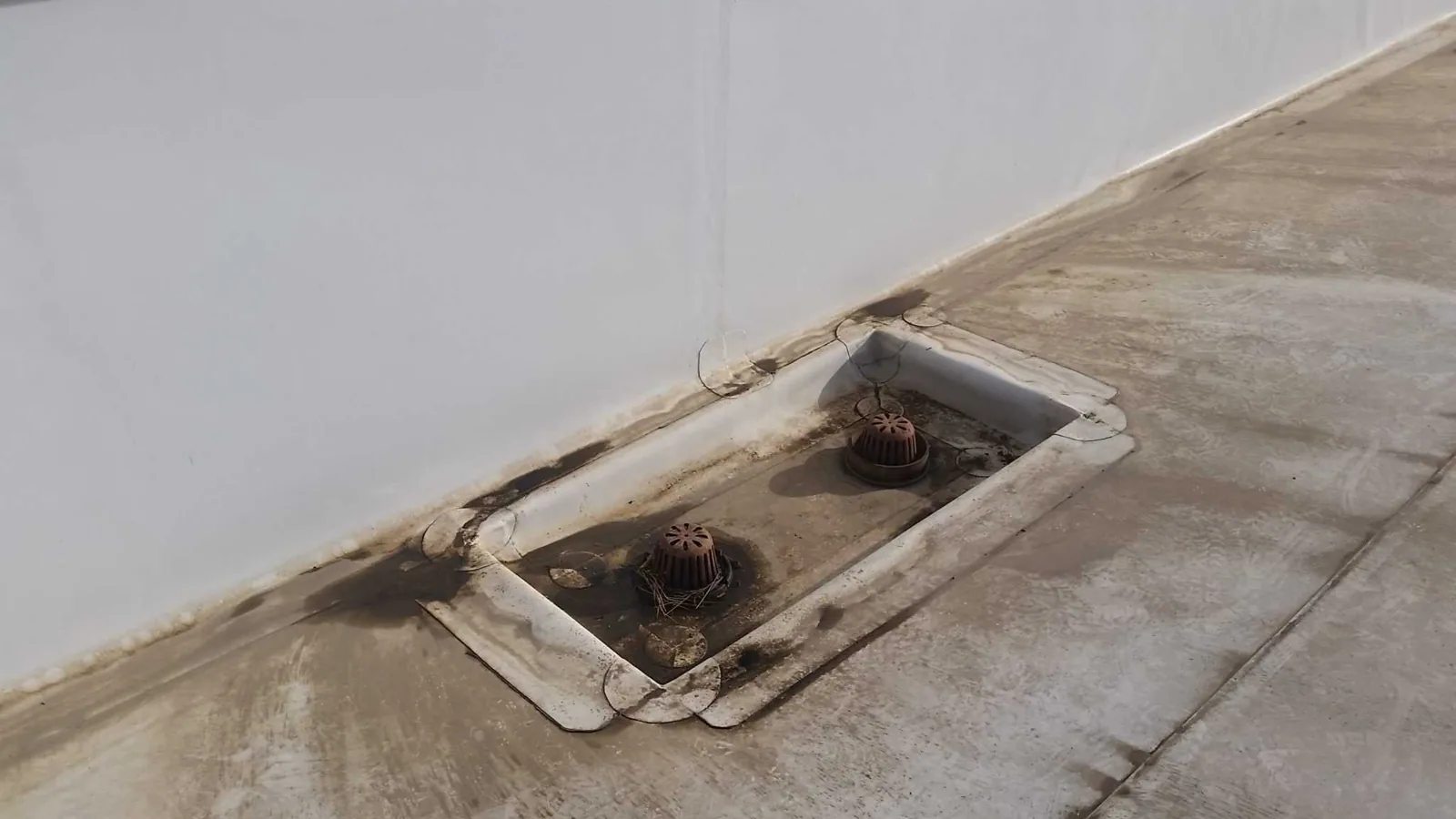
Winter leaks near a roof edge are not always flashing leaks. Ice dams work differently: snowmelt from a warm roof freezes again at the cold eave, and the pooled water behind that ridge can climb beneath edge metal and wall flashing and find its way indoors with every detail sound. Heat loss may contribute alongside sun exposure, drainage and the edge configuration. A flashing repair alone may not address the backup if the underlying cause remains.
We separate the two by timing and location. A flashing defect may leak only under certain wind, water-depth or movement conditions; a dry summer visit does not rule it out. An ice dam leak appears during a thaw, follows a line along the eave, and clears when the ice melts. Where the cause is ice, the solution involves air sealing and insulation along with a reworked edge, coping and gutter detail. We write the finding down either way, because the right repair depends on it.
Rebuilding the Detail Instead of Smearing Over It
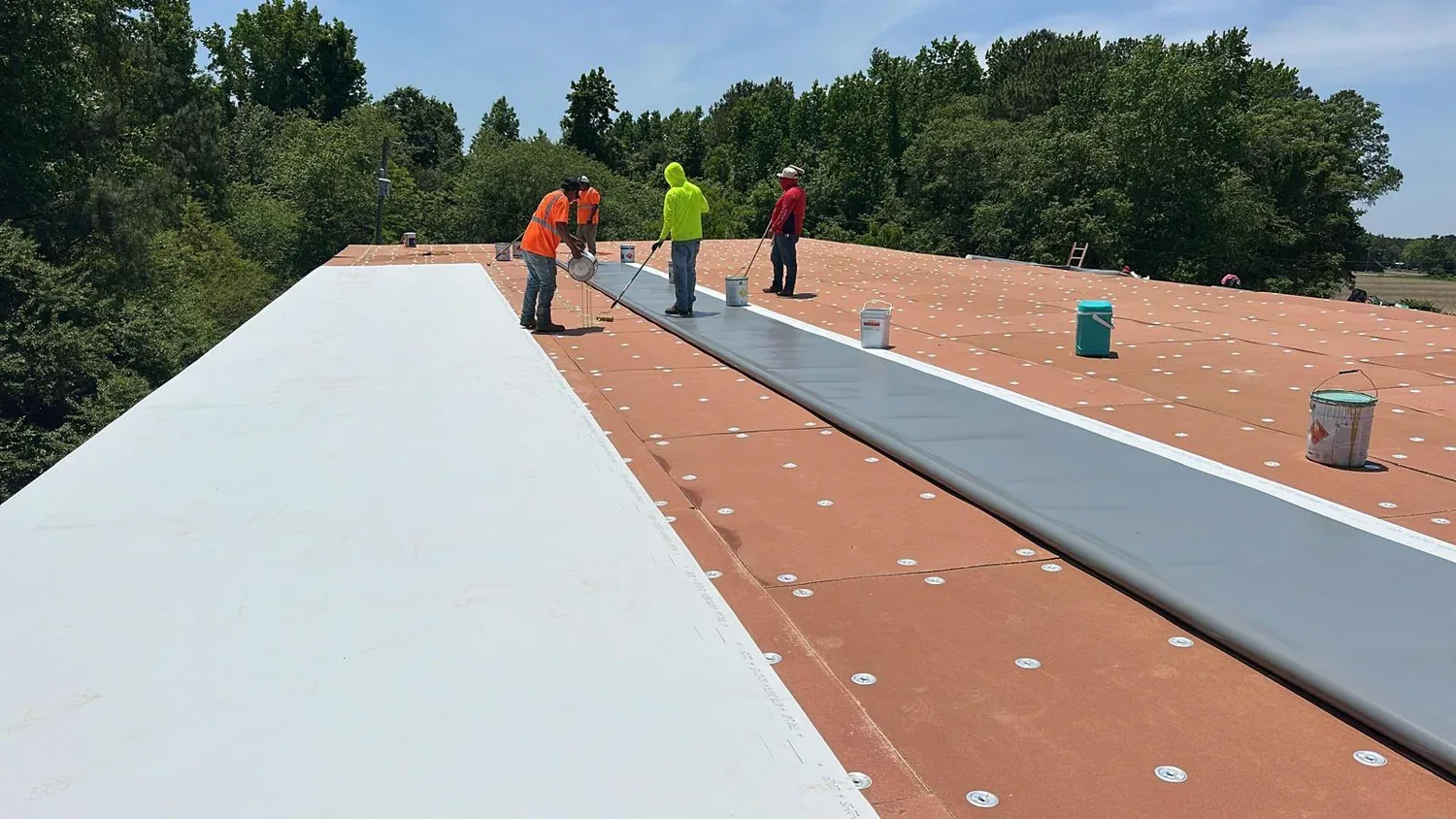
Surface sealant has limited value when the flashing is loose or the substrate has failed. Its suitable use depends on the approved detail rather than a promised number of weeks. The repair that lasts replaces the failed material down to a sound substrate. We cut out the old base flashing, clean and prime the surface, set a new flashing of the same material family as the field membrane, and weld, adhere or torch it according to that system's method. We fasten the top edge with a termination bar or counterflashing and seal it with a sealant suited to the movement at that joint.
Odd shapes call for a different approach. Around a cluster of conduits or a curb with tight corners, a liquid-applied flashing resin reinforced with fabric can be formed to the shape where a cut membrane cannot. Our built-up roof repairs call for stripping in new flashing plies, which is a different procedure from a single-ply weld. We match the repair to the roof in place and record the product, the temperature and the cure time for each detail.
Documenting the Reflash for Adjusters and Warranty Files
Every flashing repair leaves a before-and-after set: the failed detail as found, the substrate once the old material is removed, the new flashing mid-installation, and the finished edge. The set ties to a roof plan with each detail numbered, so a later reader can find any repair without a guide. If a storm caused the failure, that file supports the claim. If age or movement caused it, the same file supports a maintenance budget.
On the north edge of downtown, the Capitol complex holds the Capitol, the Judicial Center and the Senate Building, and a public building has to justify the scope it funds. A repair file that lists each detail with a photo and a condition note makes that easier. Owners in downtown Saint Paul can pair that file with commercial roof leak repair tracing when a stain has no obvious source, and a seam failure repair belongs in the same file when a seam runs into a flashing.
If the surrounding sheet also has a puncture requiring repair, we document it beside the flashing detail and describe its own preparation and joining method. The closeout record keeps two defects traceable without treating them as a single connection.
Questions We Hear
Where does flashing usually fail first on a flat roof?
Inside corners, pipe penetrations and the tops of wall flashings are the usual starting points, because those are the places where movement and sun exposure are greatest. We check each one in turn, then follow wet insulation outward to see how far the water has spread.
Is caulk a legitimate fix for a lifted wall flashing?
As a short-term seal, it can slow a leak. Sealant alone does not reattach a loose flashing or repair the substrate. The lasting fix reattaches or replaces the flashing and seals the termination, and we log the temporary patch separately so it is clear which repair is.
Why does the flashing leak in March but not in July?
Seasonal movement and ice backup can both produce that pattern. We compare weather timing, the termination and adjacent drainage before assigning a cause. Wet or frozen surfaces can limit moisture readings, so a thaw visit may need confirmation when testing conditions improve.
Do I need a new membrane to fix the flashing?
Not when the field is sound. Flashing can be replaced independently, tied into a membrane that is still in good condition, provided the old material is clean and compatible. Core samples show whether the insulation under the flashing is dry enough to keep.
What do you photograph during a reflashing?
We take the detail as found, the exposed substrate, any rot or corrosion we uncover, the new materials in place and the finished edge. Each photograph carries a date and a detail number, which makes it easy to match to the roof plan.